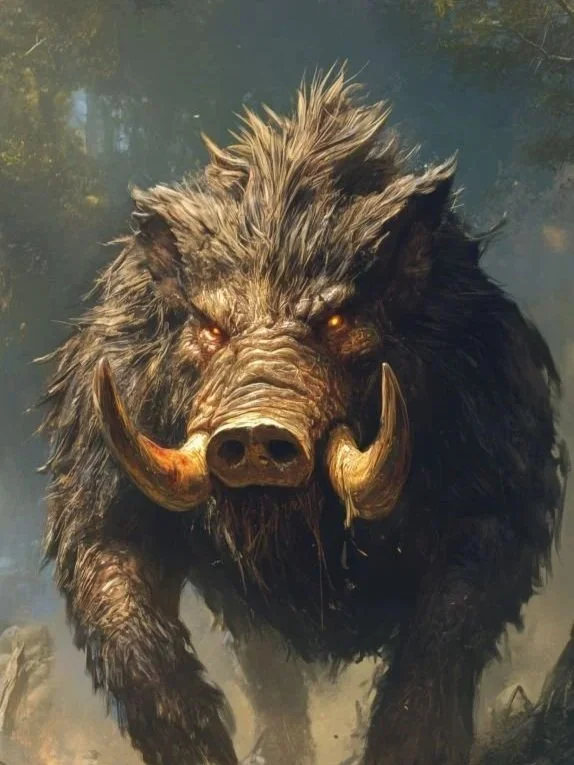
The Erymanthian Boar
When Grief Grows Teeth
Having successfully completed his third labor, King Eurystheus has decided things just haven’t been difficult enough for Heracles. He’s upped the ante, and for his fourth labor Heracles must capture the Erymanthian Boar and bring it back to Eurystheus alive.
Curious, isn’t it? That this is the second creature Heracles has been ordered to capture rather than kill, but unlike the beautiful Ceryneian Hind, the boar is not something to be approached with patience and a gentle hand.
The Erymanthian Boar is enormous, vicious, living it’s best life out there terrorizing the countryside.
On his way to Mount Erymanthus, Heracles stops to visit with the centaur Pholus, who lives in a cave on the mountain. Unlike many of his kind, Pholus is civilized, hospitable, and eager to share a meal and conversation with Heracles.
Intrigued by the Heracles’ adventures, Pholus pulls out a very large jar of wine he offers to share with his good buddy.
The wine, however, belongs collectively to the centaurs, and when Heracles opens it, the smell carries across the mountain. The other centaurs come charging in, furious that Heracles touched their booze without asking. They attack Heracles, and Heracles defends himself by popping off shots with the arrows dipped in the Hydra’s poisonous blood.
After taking part in this gnarly bar brawl, Heracles gathers up his stuff and continues on toward the boar.
Unlike the Hind, the Erymanthian Boar has zero intention of running from Heracles.
The boar is locked, loaded, and ready to rumble.
Probably nursing a nasty hangover, Heracles decides he doesn’t really want to fight this pig. Instead, he drives it back up the mountain and into deep snow, where its enormous body and powerful legs become a disadvantage. The boar struggles through the snow, exhausting itself as Heracles continues to push it farther into the frozen landscape.
Eventually, the animal is just too tired to go on. The boar goes down, and Heracles is able to capture it
Now, this part is wholly my interpretation, but I’d like to think perhaps Heracles is the inventor of the “hog tie.” I know I’m wrong, but it’s funny, so I’m keeping it. I’m also envisioning him having strapped this pig onto his shoulders like a backpack, trudging back to Mycenae, while the boar squeals and screams wee, wee, wee… all the way home.
Still shrieking and kicking its little trotters, Heracles walks through the front door of the palace with his prize, but the noise is so great and the boar is so big—probably having pooped all over Herc, because one must imagine the logistics of actually toting an unwilling boar somewhere it doesn’t want to go—Eurystheus is absolutely terrified. He didn’t actually want the boar, he asked for something he was certain was impossible, hoping Heracles would die.
Remember, King Eurystheus is a devotee of Hera, who wants nothing more than abject failure for the Mighty Heracles.
Faced with the impossible, Eurystheus comes up with the only reasonable solution available to a mighty king confronted with an enormous, furious boar.
He hides in a pithos.
Heracles has just dragged a monstrous murder pig halfway across Greece, and Eurystheus has noped himself into a bronze jar.
We can ask ourselves all day long why a puny mortal man thought hiding in a jar would save him, but that’s an article for another time.
Today, we’re talking about Heracles’ fourth labor, and how it applies to us in the here and now.
If you’re reading this and are someone who’s ever experienced grief, you’ll know that at some point, the sadness grows teeth.
You’ll hear about the stages of grief, and one of the steps we experience as we process the event that caused our pain, is anger.
Sometimes we’re angry because a loved one died. Sometimes we’re angry that the person who hurt us has never taken accountability, or has never been punished for their actions. Sometimes we’re angry at ourselves. Sometimes we’re angry at God, the universe, our families, the medical system, a boss, a co-worker, the asshole who cut us off in traffic, or the woman in the grocery store who looked at us funny on a day when we were already hanging on by a thread.
No matter the circumstances or cause, at the root of it, we’re angry because something happened that should not have happened, and there will come a day when our grief becomes a big, feral pig wearing a collar that says:
RAGE.
Imagine yourself after having experienced a devastatingly painful event, and how going to visit someone you trust, someone you call a friend, makes you feel safe enough to tell them what happened. If they’re a good friend, they listen and let you uncork, cry, scream…
But sometimes that’s not enough.
Telling one person just isn’t enough.
When we feel wronged, especially those of us recovering from narcissistic abuse who have been told to be silent, who were gaslit into doubting our experiences and our reality, who’ve spent years suffering in silence, isolated with no friends or family who even cared to ask what happened to allow us the opportunity to hear our side of the story, we want everyone to know what happened.
Very often, very naturally, we go looking for other people who will understand why we’re so angry.
Hello, to Facebook groups and those late-night internet rabbit holes where we make a post about what happened to us and suddenly discover twelve thousand strangers who have experienced something eerily similar.
This feeling becomes a vital part of our journey because we realize we’re not alone. In the moment, it can feel like a profoundly healing experience, especially if we’ve spent years being told we’re overreacting.
That we’re too sensitive and misunderstood the situation.
That if we stayed so long, it couldn’t have been that bad.
That we should just pull ourselves up by our bootstraps, get over it, be grateful it wasn’t worse, and move on.
Suddenly there’s a room full of people saying, “Oh, girl. I know.”
You read their stories, tell your own, leave a comment to say what you wish someone would have said to you. Someone responds, validates you, tells you what happened to you wasn’t okay or normal, and for a while, being angry together can feel amazing.
It’s exactly what you needed, because it’s lonely when everyone around you wants you to stop being angry because it makes them uncomfortable.
Having to smile and put on a professional face because anger doesn’t get those bills paid? Exhausting and infuriating.
There’s real value in discovering you’re not the only person who has experienced loss. There’s value in hearing language for experiences you couldn’t previously name. There’s value in realizing the thing you thought was uniquely wrong with you, may actually be evidence that you survived something legitimately horrible.
But let’s pause for a moment and remember the myth.
Heracles didn’t stumble upon the centaurs and then wander away unaffected.
He opened the communal wine, and in doing so—by no fault or intention as it was Pholus who offered to share the wine—called in the centaurs who were pissed at him for touching their stuff.
Not everyone has resources, or friends, or the ability to see a counselor or a therapist every week. We use what we have available to us, and sometimes the only thing available is found on social media.
I’m not saying don’t go there.
Go.
Absolutely go and join these support groups, but be mindful that you’re there with other people who are angry in their own way and in different stages of grieving something.
Most of them will understand you. Some will offer resources, share helpful tips and tricks, and give you opportunities to examine your own experience through unbiased eyes.
Some will disagree with you. Others will tell you what you should have done and have opinions about what you should do next.
Some of these people will be furious on your behalf, and some of them will be mad at you for doing what was right and safe for YOU. For speaking about your experience that touches something in them that activates THEIR inner Boar.
They’ll rampage for reasons that have absolutely nothing to do with you, and everything to do with the fact that they’ve forgotten their experience is not your experience.
Their morality is not your morality.
Their threshold for forgiveness is not yours.
Their boundaries are not yours.
It’s about here that Pholus’ part in the myth becomes interesting to me.
When the fight’s over, he goes for the arrow.
That small, tiny projectile that seems harmless enough to pick up and examine, the way we sometimes sit with a comment or someone else’s story and examine or compare it against the thing that wounded us.
We start asking ourselves:
What if I look at this one more time?
Maybe if I figure out exactly what happened, then I’ll understand why it happened.
If I can just understand why, maybe then I’ll know if I did or said or felt the right thing.
Or the wrong thing.
We become so fixated on the arrow called WHY, we forget it’s poisoned.
There are questions that help us understand ourselves, and there are questions that quietly turn into self-punishment.
Hopefully, we leave the centaurs—not because it was wrong to stop and share stories and wine with them, or because we’re not allowed to be angry—because we’re on a mission to heal beyond the pain and trauma, and become more than the experience or person that caused our grief.
We have our own Labor to complete.
Hopefully, hearing someone else’s story helped us recognize something in ourselves, or reminded us of the Hydra’s Immortal Head we buried, whispering the truth we needed to hear.
Maybe we discovered a question we hadn’t thought to ask, because in the past, asking questions has been the catalyst for getting shot full of metaphorical arrows.
Maybe we learned that there are other ways of understanding what happened to us.
Unfortunately, more often than not, we leave those centaurs feeling angrier and more confused than we did before, because those people aren’t ready to keep going. To dedicate themselves to The Labors Within and feel safer staying where they are.
There is no way I can ethically sit here and say, “Follow Heracles’ labors and know this is the right way to process your grief,” because there is no right way, no linear line to get through grief to peaceful acceptance.
But this is where I think the story of the Hind matters.
We can’t chase or hunt our way out of survival mode.
Imagine finally getting close enough to that beautiful creature inside yourself that has spent years running away from the dangerous lions, finally convincing her that you’re safe, that she’s safe and it’s just Dwyane in a lion costume, finally learning how to sit quietly enough that she doesn’t bolt, only for a new enormous beast to come crashing through the trees.
Pretty sure you’ve experienced at least one time when things finally felt like they were turning bright side up.
You were feeling happier, healthier, safer in your skin; you got yourself a treat at Starbies and the barista handed you the drink with a ‘it’s on the house, babe,’ that made your DAY! You got a raise, paid off your cell phone and the bill dropped in half…
And then BAM, the hot water heater explodes, the repair guy says you’ve got mold and asbestos to deal with, and the financial hit is so huge you fall right back into depression.
You could be at the grocery store and see a little girl getting yelled at by her mom, and seeing that happen takes you right back to that day when your mom yelled at you in the grocery store.
That memory—seeing yourself as a child through the eyes of an adult—is a trigger, and you find yourself so angry on that little girl’s behalf, and that the emotion follows you long after you leave the store.
Life will always happen, and the change from sadness to anger can happen anytime, anywhere, without warning.
It’s then we discover our inner landscape contains more than one creature, and we’re reminded that we’re only on the fourth Labor, with many more to go.
But for me, that’s the point.
No matter how it feels, you’re not back at the beginning.
You’re still here.
You’re still moving forward.
It’s the determination to keep going, knowing that after everything we’ve already survived, this next monster is smaller than it seems, and we’re capable of the impossible because we’ve done it over, and over again.
We’ve spent our entire lives being taught that feeling is dangerous, that having emotions means we’re selfish, unacceptable, weak, or powerless, the moment those feelings finally show up, our subconscious mind—our survival instincts that have kept us alive through 100% of our worst days—kicks in and does exactly what Eurystheus does.
It sends someone or something more powerful than us to deal with it.
Sooooooie, that Rage? She’s a big pig, she’s got tusks sharp enough to cut a bitch, and she’s ready to throw down.
Anger is loud.
It’s intimidating and powerful enough to destroy, to distract other people and us from the truth behind the rage, which is:
I’ve been hurt, and I don’t feel safe to be vulnerable, or let you see me in pain.
Consider the last time you felt ANGRY.
Not small, mild-inconvenience angry.
Angry, like you want to throw a plate or scream and stomp your trotters until everyone around you flees in terror so you can finally have a moment of peace.
What would it feel like to consider that anger isn’t the thing keeping you from healing?
What would it feel like to think about that pissed-off pig as the protector of your grief? The warrior standing between the softer version of you that’s been hit by a poisoned arrow, and the person or memory that inflicted the wound?
I think for those of us experiencing loss, intentional or voluntary estrangement, the aftermath of choosing to break cycles and become more than the people who hurt us, the lesson of the Erymanthian Boar isn’t that we need to hide from our anger or stifle it.
The Boar represents the part of us that needs to be angry in order to heal.
Our anger is allowed to exist.
Our rage is allowed to exist.
The part of us that is absolutely feral and furious about what happened to us deserves to be seen, heard, and understood.
Sometimes we can’t access the softer feeling underneath the anger while we’re still learning what it actually means, what it feels like, to be able to regulate our emotions, or even name them when we’re feeling them.
It takes time to recognize anger is the alarm and be curious about it enough to look around at what’s happening in our environment to make us uncomfortable, instead of letting the anger rampage across the countryside.
We can’t always lovingly welcome the Boar in and gently say, “I hear you. What are you protecting me from right now?”
Sometimes the Boar is charging around the room, knocking over furniture, shitting all over the carpet, screaming, FEEL THIS, DAMMIT!
Heracles doesn’t post up and yell at the boar, or drop a deuce in the middle of the field to get its attention.
At least, not so far as the myth goes…
He chases it back up the mountain into the snow, until it’s too tired to fight.
Exhausting your anger isn’t what we’re going for, though. Recognizing the anger as an alarm going off, alerting us that a softer voice within needs to be heard?
This is the way.
If you’re a mom with toddlers, or you have younger siblings, or niblings who have had a raging meltdown in reaction to being told their blue sippy cup is dirty but the pink one is clean and full of yummy juice, you’ll know what this boar sounds like.
It’s screaming so loudly you can’t actually hear yourself think, let alone identify what the problem actually is, because the pink cup and the blue cup are exactly the same.
As far as solving the problem? Until that blue cup is clean, full of the appropriate beverage, and in the hands of that tiny, red-faced, screaming child, as far as they’re concerned the sky is falling, someone touched the Elf on the Shelf with their bare hands, and Peppa is bacon.
A lot of us who are children of unstable, unregulated, emotionally stunted parents will hear the phrase “parentification” during therapy or counseling.
If you haven’t heard it, parentification is when a child has to become the parent because the adults around them aren’t able or willing to do the parenting. We learn to manage everyone else’s emotions, keep the peace, take care of practical things, and put our own needs aside because there simply isn’t room for us to be the child.
So we stopped needing.
We stopped feeling.
We learned to be small and quiet, how to do for everyone else before doing for ourselves.
Now, here we are all grown up. We’ve accepted that being numb and surviving is no longer a state we’re willing to live in, that we are worthy of needing things and deserving of care, but we’re having to be parents to our own inner child who wants the blue cup, not the pink cup, possibly while being the parent to our actual children who want the green cup, and…
It’s a lot of cups.
It’s easy to forget or slip back into old habits when we get overwhelmed.
I’m considering that phrase, ‘the things we say in anger are usually the truth.’
I’m imagining that part of us that’s been pushing the truth down into a jar, afraid of what will happen if it’s allowed to come through the front door. That fears speaking the truth, because in the past it was only ever used against us.
But now there’s no holding it back, and underneath all that rage, there’s a softer voice that needs to be heard.
That’s been waiting all this time to say:
I was hurt.
I was scared.
That wasn’t okay.
I needed someone to protect me.
The Hind and the Boar belong in the same landscape.
The tender part of us deserves protection.
The angry part of us deserves to be heard.
Maybe the mission is learning how to sit in the woods of our inner landscape, balancing the frightened Hind in one hand, holding the reins of a pissed-off boar with the other, and being curious enough to ask each of them why they’ve shown up and what they have to say.
Healing doesn’t mean choosing which creature gets to stay.
I think it’s learning how to bring them both home and letting them know, it’s safe to be here.
However, safe doesn’t mean letting your emotions run amok without boundaries.
A wise person once said, “You can have your say, but you won’t always get your way.”
The Boar can be angry. It can stomp around, snort, squeal, be the security system that tells us something is wrong, but it doesn’t get free rein of the house.
You have the power to get snoot to snoot with it and say, “This is our home, and everyone who lives here deserves to feel safe. So if you shit on my new rug, scare the deer, or start tearing down the walls, you’re going in the jar for a time-out.”
And with that, we’ve discovered together that sometimes healing goes hand in hand with boundary enforcement, animal husbandry, and self-written permission slips of mythic proportions.
Heracles still has eight more Labors to go, and spoilers, King Eurystheus has learned absolutely nothing about what happens when you send a demi-god in a lion costume out into the wilderness with a problem and vague directions on how to solve it.
We’re off to the Augean Stables next.
You can bring the pig, but all service animals are required to be leashed during the tour.
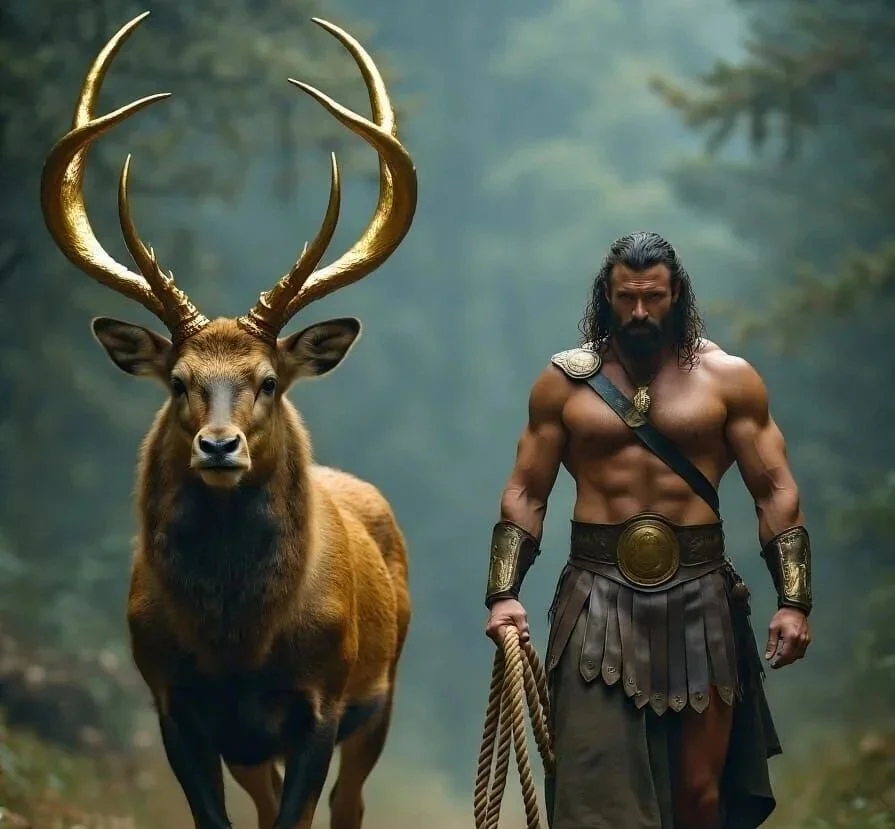
The Ceryneian Hind
When Healing Becomes a Hunt
After slaying the Hydra, King Eurystheus gives Heracles what seems like a far less dangerous assignment.
For his 3rd Labor, the king commands Heracles to capture the Ceryneian Hind and bring it back to him alive.
At first glance, it almost sounds easy.
Or at least, a challenge less likely to result in his gruesome death.
For those of us who aren’t in the know, a hind is essentially a deer.
This particular hind was said to be enormous—some stories describing it as being as large as an elephant—and, its gigantic size aside, this is no ordinary deer.
The Ceryneian Hind is sacred to the goddess Artemis.
Ancient historians describe the Hind as extraordinarily beautiful, with golden antlers and bronze hooves that flashed in the sunlight.
It could outrun an arrow in flight and was said to have been one of five magical hinds Artemis captured while they were grazing beside the river Anauros.
She kept four to pull her chariot, but the one Heracles was sent to capture was the crafty one who wasn’t interested in a life harnessed to other deer to haul some lady’s chariot.
So, the Hind escaped and fled into the forests around Ceryneia, where it remained under her protection.
There’s no gender assigned to the Ceryneian Hind, but as I’m a counselor who works with women and this is MY interpretation, this hind is female.
So from here forward, she’s a she.
Now, Heracles doesn't catch the Hind in an afternoon.
He chases her for an entire year.
Over mountains, through forests, across burning deserts, rivers, some versions say the hunt took him as far north as the land of the Hyperboreans, a mythical paradise beyond the reach of winter.
Eventually, the Hind pauses to drink from a spring or slows from exhaustion—different ancient authors tell it differently—and Heracles finally captures her.
As Heracles begins leading the Hind back to Mycenae, Artemis appears.
In some versions, she's accompanied by her twin brother, Apollo, but in every story, Artemis is PISSED.
The Hind is one of her sacred animals, and this guy—never mind that he’s her half-brother—is taking it.
Heracles is an honest man, so he tells Artemis he’s been commanded to complete this labor and promises that once he’s shown the Hind to Eurystheus, he will return her unharmed.
Reluctantly, Artemis accepts Heracles is a man of his word and allows him to continue.
When Heracles finally reaches Mycenae, Eurystheus eagerly sends his servants forward to claim the beautiful golden Hind.
Instead, Heracles asks Eurystheus to come get her himself.
As Eurystheus reaches for the animal, Heracles releases her.
The Hind immediately bounds away and heads back to her forest in Ceryneia.
Heracles completes the labor exactly as instructed, without betraying his promise to Artemis.
Perhaps a mythic example of malicious compliance?
I think so.
When I was young and first learned about the Ceryneian Hind, I only ever cheered for Heracles because he finally caught her.
It was a tale of victory to me.
The mighty hero defies the odds and completes another labor.
Older now, with plenty of journeys that took so many years... I've sat with this labor and find myself wondering whether the Hind isn't something far more elusive.
Peace.
Or at least the version of ourselves that existed before we became convinced we needed fixing.
I know I hunted healing and spirituality and THE THING that would give my life meaning with dogged determination.
With the belief that if I could capture THE THING, aka The Hind, then I’d finally have the answers I needed.
If you’re anything like me, one book becomes five.
A meditation practice turns into breathwork, then somatic exercises, then nervous system regulation, then the latest modality everyone's just discovered that will absolutely change your life, but in reality it’s literally a 2,000-year-old practice that shaped monarchies, repackaged and rebranded to fit in with the needs of society today…
Before long, you've got a bookshelf full of travel guides on how to get to the same destination through a thousand different roads, a journal full of half-finished exercises, and enough supplements in the kitchen cupboard to open your own apothecary, and every new thing arrives carrying the same quiet hope:
Maybe this is the one.
Maybe this is finally the thing that brings me home.
And then you wake up one morning still grieving, still anxious, still tired, still unable to figure out what the hell it means to ‘regulate your nervous system,’ because you’ve tried all these things you were told would work, and they worked for other people, but they did NOT work for YOU.
And the power of positive thinking? HA!
Some days, it’s all you can do to brush your goddamn teeth.
But you do it, and then after accomplishing what feels like the proverbial Herculean task, you remember you’re supposed to be practicing gratitude.
So you take a breath and force yourself to smile and feel grateful to have toothpaste, teeth, clean water, a bathroom... but those bills aren’t going anywhere and working, peopleing… that’s why you’ve been doing all these things to feel good enough to handle life.
At some point, when it’s a struggle to stay positive, to stay the course, to keep going even though what we desire or need is beyond our reach, we quietly decide we must be doing the healing thing wrong, because nothing has changed.
Now you’re here, still trying, because hopefully what I’ve got to say has piqued your curiosity.
And I’m here, proposing that perhaps Heracles’ third labor offers another perspective.
Before we get to it, let’s briefly recap the first two labors.
The Nemean Lion
Heracles' belief: "I'll defeat this the way I've always defeated everything."
The truth: Old tools don't work forever. Sometimes the answer is hidden within the very thing we're fighting.
The Lernaean Hydra
Heracles' belief: "If I just keep trying harder, eventually I'll win."
The truth: Not every battle is won through effort. Some require wisdom, relationship, and a completely different strategy.
Now, chasing the Hind, this hero—who, like you, has slain his share of monsters—is spending an entire year pursuing an animal he can’t catch, can’t trap, and can’t kill to make things easier.
He has to bring her back alive, but every day, the Hind eludes him.
As he passes through villages asking for directions or rumors of sightings, there are probably strangers who know nothing about Heracles as a person, who have no idea what he’s done or what he’s capable of, telling him to give up because it just can’t be done.
I wonder if Heracles looked at those people, teeth clenched, exhausted and trying to make a valiant effort to smile, and said, “Well, I don’t have another choice. I have to get this Hind to complete my labors.”
The longer the hunt goes on, the less evidence there is that progress is actually being made.
I imagine at some point on the journey, Heracles started hyping himself up the same way we do when we tell ourselves it will all work out if we just keep trying, keep hunting, if we keep asking for directions, if we just keep believing.
And I wonder if he started to feel the burn.
The resentment as the Hind led him down another path, or back the way he came, across the desert for three months where he was dying of thirst, only to run him through a river ten miles wide.
I can hear the echo of my past self now…
I’ve already been here.
I tried that, it didn’t work!
No, I have that supplement already, I’m still waking up in the middle of the night.
What do you mean I have to climb up ANOTHER MOUNTAIN!?
But if I do this, it’ll be worth it, right?
You promise?
Okay, I believe you because you look like YOU have your life together…
What do you mean you’re still ‘figuring it out?’
Okay, yes, all that resonates and I feel called out, so it means there’s a wound there I need to deal with, right?
Wait, how much is that course?
Uh, no, I’ll just do it myself, thanks.’
I think about the resentment of trying something new after you’ve been burned. Believing you need to do something if you want things to change, but doubting it will actually work.
Still, you’ve come this far and spent too much money, so at some point, it almost becomes a point of pride.
Then a new voice enters the chat, and we say to ourselves—
This book better have what I need.
If this therapist turns out like the last one, I’m done with therapy.
This meditation/certification/course/retreat, is definitely going to change my life because it worked for that person who’s now working remote and traveling and living the life I desire. If they can do it, so can I.
I've spent $4,000. This HAS to be it, because it wouldn’t be so expensive if it didn’t work.
We often judge a healing modality by whether it "worked."
We invest, we hope, we dig in deep, and we believe it will work if we put in enough effort, if we believe we’re doing the right thing.
Then...
The teacher disappoints you.
Maybe the community that initially made you feel so safe and seen turns down a path that feels... culty.
Or they reveal themselves to not be as inclusive, or as enlightened, or as knowledgeable as they claimed.
Maybe the promises of health, wealth, and abundance don't materialize despite following the method or system to the letter.
You see that Live, Laugh, Love sign, and it actually makes you angry, because who the hell can live, laugh, love in these conditions?
Now you're grieving the original wound and the hope you placed in the cure.
Desperation arises.
You tell yourself you need to make this work because you want to feel better.
You fear it will never get better. That this is simply the way life is for you.
The pressure to perform sets in because you were very vocal about following this new, incredible person.
You bought all their merch, went on the trip, invested in their method, told your friends and family what a great book that was, but now you just want to chuck it in the fire pit and pee on the ashes in defiance of that teacher, their method, their crackpot theories, and can’t believe it took you this long to realize how that system was never about healing.
It was about capitalizing on your fear, on your feelings of being untethered, chasing after that sacred thing, desperate to capture it, because if you do, then your impossible labor will finally be completed.
I remember having a conversation with my therapist about how here I went again, trying something new without finishing the last thing because the HD got lost to the AD, and I found the Squirrel of Tism to lead me down a new rabbit hole coated in puppy breath scented dopamine.
I was really upset about that, voicing this pattern I had noticed: how I never finish what I start once it no longer makes me feel the way I wanted or needed it to.
More upset about how I would be perceived by peers and clients, imagining they’d think I was a wishy-washy flake who couldn’t finish projects, always on the hunt for the next best thing.
We talked about what it meant to be someone who doesn’t naturally produce dopamine, how that becomes my Ceryneian Hind, and my personal chase to catch it.
This wise, hilarious, clever, accomplished, wild woman with a Ph.D. whom I adore said:
"What if you think of it like dating?"
And I was like, "Whaaaat?"
Because we were talking about study and practice and healing, not romantic relationships.
But I went with it because I could see where she was going, and the perspective shift was intriguing enough to follow.
It became a permission slip, if you will, to stop being so hard on myself for trying new things.
The purpose of dating someone is to get to know them better, right?
To find out if you share the same interests.
If they actually look like their profile picture.
If being with them makes you laugh, or if their political views on gender and equality make you want to gag.
You decide if spending time with them feels good.
If you like them as a person. If you’ve got chemistry or if it’s just hormones.
If they fulfill you, or if you feel drained after spending five minutes in their presence.
If they’re curious about you, or only want to talk about themselves.
If they remember your drink order, or take you to the sushi place after you explicitly said you hate fish.
If they’re someone who’s polite to waitstaff, or if they’re the type of person who snaps their fingers at the bartender.
We date to find out if it’s good, or not good.
And if it’s not good, we date someone else with, hopefully, having gathered more data about what does not spark joy and how we can recognize those signs before we go and shave our legs.
Sometimes, the next date is tomorrow.
Sometimes, we don’t try again for months.
Years.
But when we break it down to the brass tacks, it’s a hunt.
A long journey toward ultimately deciding whether you are or are not safe with someone.
Whether they’re a potential spouse, a long-term relationship, or just someone you call when you want to get drinks with another human you’re attracted to.
So what if all those healing modalities we tried were "dates"?
What if—in a world of pre-packaged products sent to a social media influencer to promote and sell— we dated all those things to learn more about what does and does not feel like peace and wholeness for US,?
What if we went to that retreat where a perfumed priestess sent us out into her metaphorical petting zoo to find the Dodo of Discernment.
The Emu of Embodiment.
The Armadillo of Abundance.
The Hippo of Happiness.
The Walrus of Wholeness.
The Pachyderm of Peace.
The Capybara of Creativity.
The Sloth of Self-Awareness.
The Manatee of Mindfulness.
The Goldfish of Gratitude.
The Wildebeest of Wisdom.
The Catahoula of Calm.
And before you go out there to collect them all, she explains which treats you need to feed all of them to make them come over to you so you can take them home.
But then when you get home, they run right back to her, because taking them home and keeping them are two different master classes.
So what if all of those things aren’t meant to be hunted and captured?
Healing doesn’t happen in accordance with the availability on our schedules.
It doesn’t care that we want to be "better" by this time.
It doesn’t respond well to being chased or cornered, exactly the same way a frightened deer doesn’t come closer because we run after it faster.
It comes closer when it senses safety.
Now, this is less literal and more of a sensory myth comparison, because yes, a wild deer isn’t about to come over and let us pet them just because we project peace and calm.
Although...
I have seen that guy who holds seeds in his hands and sits so still and is so calm that squirrels hop into his hand, and he patiently moves one little bit at a time with pliers to pick ticks off them.
So it’s possible.
But we’re in the land of myths and legends here.
M’kay?
If any of this feels true, I wonder if maybe healing practices deserve the same consideration as our views on dating.
We don't have to find THE ONE on the first try.
In fact, most everyone would be shocked if you did.
True, it does happen, but it’s about as rare as a frog named Schrödinger with ginger-striped fur these days.
We can walk with a book, a meditation practice, a therapist, or a philosophy for a season, receive what it genuinely offers, thank it for the distance we traveled together, integrate all that made us feel good and safe and happy, and, when it's time, continue the journey with something else.
We had a relationship with those practices.
We learned important, meaningful things.
But none of them came with a contract stating those relationships had to last forever in order for them to be meaningful.
The truth is, every practice that teaches us greater compassion, every conversation that helps us understand ourselves, every guide who carries a torch for a little while, every path that reminds us we aren't alone, every journey we take, changes us.
Not because we've finally discovered the magic key, but because we've become the peace we needed all along.
With every “date” of a new modality, we learn to be just a little more patient with ourselves.
A little more compassionate, and a little less afraid.
Some of us read the myth of the Ceryneian Hind and will imagine ourselves as the Hind, running away from the emotions and monsters chasing us.
Away from pain, shame, anxiety, from the past, from people, from the woulds and the shoulds that roar like lions.
But maybe we're Heracles, too. Chasing after something shiny and beautiful through every forest, stream, and desert that looks appealing because we hope we’re going to eventually catch what we’re chasing, and eventually, it’ll lead us to the right place.
The safe place where we can finally rest.
I think Heracles represents the part of us that’s strong enough to wake up every morning determined to create the peace we didn’t have growing up.
The part determined to become whole by undertaking the journey to find the version of ourselves we dream of becoming that’s somewhere just beyond the next book, the next breakthrough, the next retreat, the next therapist, the next meditation app.
It all matters, even if we don’t know how or why yet.
Imagine what the Hind saw when Heracles burst into the sacred forest.
A big mountain of a man wearing the skin of the Nemean Lion, wearing the head like a helmet, probably smelling like a dirty beast…
I mean, really, the Hind reacted the way any sane person would if a lion started running toward them.
The myth says the Hind finally stops because she’s too tired to run anymore, or because she finally arrives at that stream with the crispy filtered water she likes.
That river that was ten miles wide? Tap water.
But what if, after a year of being chased by what she perceives to be a lion, the Hind finally realizes it’s just a really big guy who sorta looks like Dwayne Johnson wearing a lion hat, and he’s actually the mighty Heracles who’s got this whole gentle, determined stalker vibe going for him?
Something to think about…
Anyway, the Nemean Lion taught us that sometimes the thing we’re trying to defeat isn’t something we can overpower with weapons.
Sometimes the strength we need comes from walking into the cave where the thing we fear lives, discovering what it’s made of, taking the time to try something new in order to defeat it, and realizing that the very thing we thought would destroy us may become the source of our protection.
The Lernaean Hydra showed us that not every battle is won by trying harder.
Some wounds grow more heads as we’re trying to heal them.
It asks us to recognize when we need a different strategy, when we need another person beside us, and when the truth beneath the pain deserves to be honored rather than destroyed
So now, before we leave Mycenae once again to undertake another labor, I have to ask...
What if the thing you’ve been chasing is more like a frightened, sacred creature that’s survived all this time because it trusted its primal survival instinct that says, WE RUN FROM LIONS!
And what if that sacred creature thinks you’re the lion?
What if you’ve been chasing it so relentlessly that it’s forgotten what it feels like to be approached with gentleness?
What if the lion was never actually a lion, but just a belief, or a fear, wearing a lion shaped hat?
What if Heracles’ 3rd labor is offering us myth and metaphor to teach us how to approach ourselves with enough patience, compassion, and gentleness—even if that journey takes a year, or longer— so that the parts of us who have been running for all this time, finally realize they’re safe enough to come home?
How would that change the way you approach yourself?
Here, I invite you to consider both parts of this myth.
Imagine yourself preparing for a date.
You’re the mighty hero in a lion costume giving the ol’ flex in the mirror to show off those guns you’ve worked so hard for. You’re brave enough to keep showing up, determined enough to keep searching, even when the path is long and the dating apps feel like wading through that Hydra’s boggy, nasty, stinky swamp.
But you’re ALSO the shining Hind, gold highlights, fresh outta the pedi chair, claws and paws a gorgeous copper color, just a sacred creature who needs some good water and a place to finally rest.
What would that date with You and Yourself look like?
I sure would like to be a fly on the wall to see how it plays out!
So here we are, friends. The Hind has returned to Artemis, and the forest is quiet again, but there’s another creature with a hella nasty temper just around the corner.
Come on, bring your water; the Erymanthian Boar is waiting.
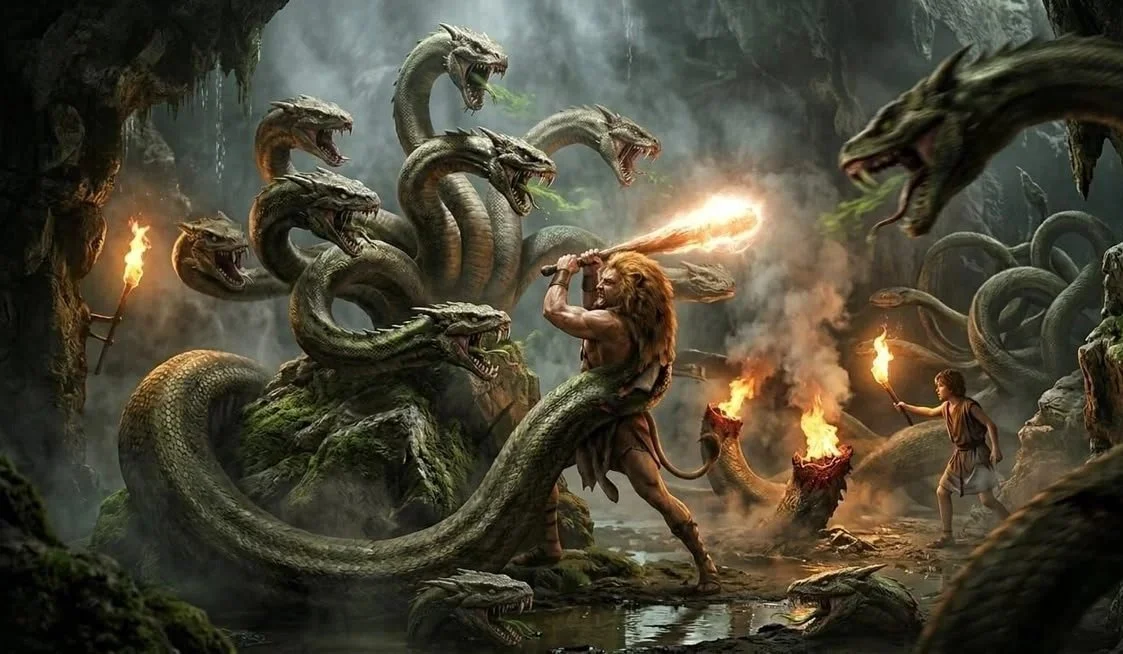
The Lernaean Hydra
When Survival Becomes the Monster
Today, we leave the valley of Nemea, journeying with Heracles into an altogether different landscape.
Gone are the rocky hills where strength could be tested against tooth and claw.
The path now descends into the marshes of Lerna, a place the ancient Greeks regarded with both fascination and dread.
Fed by deep springs and shrouded in mist, Lerna was believed to be one of the oldest and most mysterious places in Greece.
A landscape where the boundaries between the living world and the Underworld seemed especially thin.
Here, waiting among the reeds, lurks the Lernaean Hydra.
Born of the monstrous pair Typhon and Echidna, the Hydra is no ordinary serpent.
Ancient sources describe it as a massive water snake with many heads, most often nine, though some traditions give it far more.
Its breath is poisonous.
Its blood is venomous.
Even the marsh surrounding its lair has become corrupted by its presence, as though the creature's very existence seeps into the land itself.
When Heracles finally confronts the beast, he does what any hero would do.
He raises his sword and strikes.
One head falls.
Then, before his eyes, two more emerge from the wound.
He cuts again.
The creature grows stronger.
Again.
More heads.
Every successful blow leaves him facing a larger monster than the one he began with.
Imagine his frustration.
Just as he did with the lion, Heracles falls back on what has always worked before.
He’s bravely waded into the swamp. He’s strong, relentless, but the harder he fights, the more impossible the labor becomes.
Somewhere in the middle of the battle, standing knee-deep in the marsh with the Hydra growing larger before his eyes, Heracles is forced to confront a terrifying possibility.
The problem isn't that he isn't strong enough.
The problem is that he showed up expecting decapitation to do the trick.
He was told to kill the Hydra, not that it would grow new heads and get bigger.
It happens a lot in Greek Mythology that the monsters fought by heroes are so much more than they seem, and I wonder how many of us arrive at the same realization when it comes to the labors we undertake on our own healing journeys, and what happens when we start confronting the truths of our past.
Children believe love can be earned because they have to.
Their survival depends upon it.
So they become quieter.
Kinder.
More helpful.
More accomplished.
More responsible.
At first, these adaptations work. They help us survive. They help us make sense of a world that otherwise feels frighteningly uncertain.
So we keep using them.
We carry them into friendships, iromantic relationships, the workplace, into parenthood. Into every corner of our lives, until one day, much like Heracles in the swamp, we begin to notice something unsettling.
No matter how hard we swing the sword, the heads keep growing back.
The promotion doesn't quiet the voice that says you're not enough.
The perfect relationship with a partner who ticks all the boxes, doesn't erase the fear of abandonment.
The endless people-pleasing doesn't finally earn the unconditional love you've spent your life chasing.
The finish line keeps moving.
Not because you've failed.
But because you were never meant to find it.
That's what makes the Hydra such a powerful companion for those of us healing from trauma.
Think about someone raised by a narcissistic or emotionally immature parent.
Nobody sits them down as a child and says:
"Here's the game. You'll spend the next thirty years trying to earn something I'll never actually give you."
Like Heracles, they discover the truth one disappointment at a time.
"I got straight A's, why wasn't that enough?"
"I became successful, why are they still disappointed?"
"I set a boundary, why am I suddenly the villain?"
"I went no contact, why do I still feel guilty?"
Every question is another swing of the sword.
Every answer another head.
And it's not that the rules keep changing, it’s that the game was created to ensure we would never stop swinging the sword.
That the monster would keep growing and growing until it was so large, we started to believe there was no way to ever escape it or defeat it.
We spend years believing the labor is to become stronger.
Kinder.
More accomplished.
More forgiving.
More indispensable.
We mistake exhaustion for progress because every swing of the sword feels like we're doing something. That if we stop swinging, stop fighting, we’ve failed.
But the Hydra isn't measuring our effort.
It's feeding on it.
Which brings us to Heracles’ cousin, Iolaus.
Unlike Heracles, Iolaus wasn't remembered for extraordinary strength.
He wasn't the hero destined to perform impossible labors.
He carried no legendary reputation of his own, but when I consider him as an individual, I think he’s the most practical person in Heracles’ life.
He was the person on the outside looking in, seeing the situation from a broader perspective, and had the brilliant idea to cauterize the wounds before a new head could grow back.
The labor itself wasn't impossible.
But it was impossible for the version of Heracles who believed he had to do it alone.
Standing knee-deep in the marsh, his nervous system consumed with surviving the next attack, there was no space left for curiosity.
There was only reaction.
Slash.
Another head.
Slash again.
Another head.
That's what trauma does. It narrows our world until survival becomes the only story we're capable of telling. So, let’s take a moment to consider something else.
Symbolically, historians tell us the heads of the Hydra represent fear and resilience.
Personally, I wonder if the Hydra's heads are more than just fears.
I wonder if they're stories made to sound like our own voice, or the voice of someone else we trusted.
If every head could speak, I wonder what it would say.
Don't be so loud.
Don't be so quiet.
Don't outshine anyone.
Don't disappoint anyone.
Be grateful.
Earn your place.
Don't ask for too much.
Don't trust anyone.
Don't let anyone leave first.
Stay useful.
Stay small.
Stay afraid.
As we start to address those voices, examine those beliefs, cauterize those wounds, sometimes it feels like it’s getting worse and the monster itself is getting bigger, and perhaps that’s why I always adored Iolaus whenever it was time to sit and watch Heracles: The Legendary Journeys
The myths of our past are built around a central belief that we should be able to do it alone. That asking for help somehow diminishes the work we've done or downplays the courage we've shown.
But as Iaolus demonstrated, even the strongest hero in Greek mythology needed someone to stand with them in the swamp, willing to carry a torch.
But wait!
The story isn't over yet!
There’s still one head of the Hydra left, and unlike all the others, this one is immortal.
No matter how courageous Heracles has been, no matter how ingenious Iolaus proves to be, no matter how many heads have fallen, this part of the Hydra can’t be destroyed.
In the myth, after Iaolus has used the torch to cauterize all the wounds and only that one immortal head remains.
Heracles cuts it off, the body of the Hydra dies, and Heracles buries that final head beneath a great stone.
We could spend hours debating why, but as we’re examining myths as metaphors, I wonder what the Immortal Head represents for us.
If the other heads told us contradictory lies, what if the Immortal Head is the only one that tells the truth?
Not the stories we've had to invent in order to survive.
The truth beneath them.
The truth that your childhood wasn't what you needed.
That someone failed you.
That what happened to you should never have happened.
Whatever that truth was, I invite you to consider how many heads the Hydra had to grow, how many stories it had to tell in order to silence the truth told by the Immortal Head.
We already know how Heracles' story ends.
We know he survives the labors and becomes one of the greatest heroes in Greek mythology.
But he didn’t know that while he was standing in the swamp.
He didn’t know, as the Hydra's heads multiplied, his impossible task would one day become legendary.
And neither do we.
When we’re in the middle of our own labors, we rarely know which moments will become the ones that transform us.
We don’t begin our journeys because we want to become heroes.
Most of us begin because we want peace.
We want the pain to stop. We want to understand what happened.
We want to finally reach a place where we’re no longer fighting the same battles over and over again.
And I’d like to think that’s what Heracles wanted when he stepped onto the path the Oracle of Delphi laid before him.
He didn’t come to her seeking glory, or immortality.
He didn’t want a place among legends. He wanted peace.
So, here we are at the end of this labor.
The Hydra lies defeated, the danger has passed, and we can finally leave the swamp.
But without all the Hydra’s heads reciting the old stories, there are new questions that can finally be heard in the silence.
Who am I without any more monsters to fight?
What do I want when my entire life has been organized around what I was trying to escape?
Can I move toward something beautiful without trying to capture it, control it, or prove I deserve it?
The Hydra is slain, and Heracles leaves the darkness of Lerna behind.
Beyond the swamp, the forest waits.
2 labors down, 10 to go.
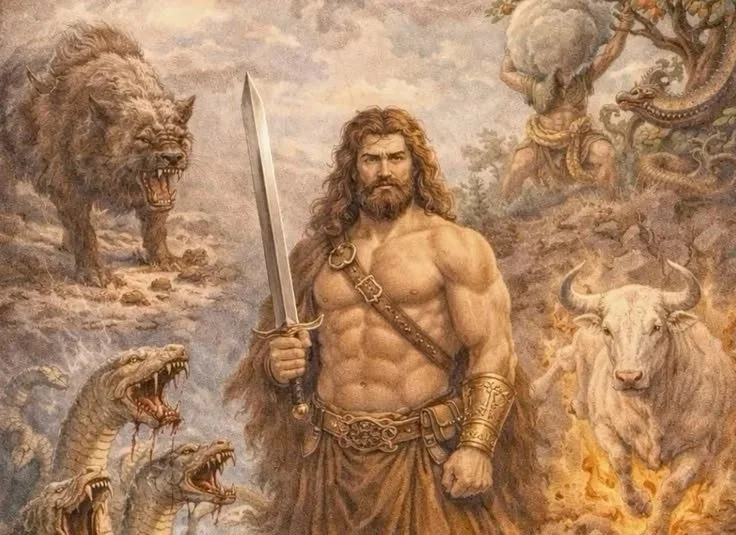
The Labors Within
Heracles as a Map Through
Grief, Estrangement & Transformation
We've all met Heracles (or Hercules) at one point or another in our lives.
Maybe it was through a children's book.
Maybe it was the larger-than-life hero of Saturday morning cartoons.
Maybe it was Hollywood's version of the myth, all rippling muscles and impossible feats.
Or maybe, like me, it was Hercules": the Legendary Adventures.
However we first encountered him, most of us were introduced to the same Heracles: the strongest man in the world.
The son of Zeus, a demigod.
The monster slayer.
The hero who marched from one impossible challenge to the next until every beast had been conquered and every kingdom saved.
It's a thrilling story.
But it's only part of the story.
Because if we remember Heracles only for his strength, we miss the reason he needed that strength in the first place.
Before there was the Nemean Lion, before the Hydra, before Cerberus and the golden apples, there was a man whose life had been shattered.
A man forced to confront the unimaginable consequences of madness, grief, and loss.
The labors were never a quest for glory.
They were acts of atonement, endurance, and, perhaps most importantly, transformation.
When we read the myth through that lens and apply it to grief and trauma work in the present day, the monsters begin to take on a different shape.
.
At face value, the 12 Labors are stories about courage and heroism.
But in truth Heracles' story doesn't begin with heroism.
It begins long before he ever becomes the mighty hero.
In the myth we know, Heracles was the son of Zeus and the mortal woman Alcmene.
Disguising himself as Alcmene's husband, Zeus slept with her, and Heracles was conceived.
Hera, Queen of the Gods and wife of Zeus, finds out she’s been subjected to yet another betrayal by her husband.
Her anger is directed primarily at Zeus's infidelity, but—as is so often the case in Greek mythology—it falls upon the innocent mother and child rather than Zeus himself.
Fun fact: In Greek translation, Heracles literally means, ‘Glory of Hera’ or ‘Fame of Hera’
Which is pretty ironic considering Hera hated his guts.
Throughout Heracles' childhood and adolescence, Hera placed obstacle after obstacle in his path.
Yet every trial he survived only deepened her resentment.
As an adult, Heracles married Megara and they had several children together.
Finally, fed UP, Hera decided to end his happiness once and for all.
She cursed Heracles with a madness so consuming that he lost all awareness of reality and murdered his wife and children, believing them to be monsters sent to attack him.
When the madness lifts, he’s confronted with what he has done.
Importantly, in many ancient versions, Heracles isn’t morally responsible in the way we might think today.
His actions occur under divinely imposed madness, but no matter who or what caused it, he still has to live with the consequences.
Seeking redemption, Heracles journeyed to the Oracle of Delphi.
There, he was instructed to serve King Eurystheus and complete twelve seemingly impossible labors.
Only after completing them all canhe finally earn redemption for having killed his family and be released from Hera's relentless persecution.
Spoiler: Hera doesn’t stop even after Heracles completes his labors.
But, for this series, that little tid-bit is neither here nor there.
Whether we quantify Heracles' madness as divine punishment, psychological collapse, or symbolic trauma doesn't really matter.
The important thing is what comes afterward.
Everything Heracles knows has been destroyed.
He awakens to the knowledge that his life has become divided into a before and an after.
Anyone who has lived through grief, abuse, betrayal, addiction, illness, or profound loss understands this division.
There’s the person you were before the world shattered and the person left standing in the rubble of the aftermath.
As we use stories to shape our understanding of ourselves in the here and now, each one of Heracles’ labors becomes are interpreted a bit differently.
In this series, I'd like to invite you to consider the 12 Labors not as a roadmap to heroism and monster slaying, but an opportunity to look at our own stories, our own impossible labors, and perhaps see them in a new light.
The Nemean Lion
When the Weapons That Saved You Stop Working
Heracles’ first task is to journey to the valley of Nemea and kill a lion that has been terrorizing the countryside.
It sounds exactly like the sort of feat we'd expect from Greece's greatest hero.
Surely this is where the legend begins!
With muscles, weapons, and an epic battle.
But the lion possesses one extraordinary gift.
Its hide is so strong, no weapon can pierce it, essentially rendering it indestructable.
.
Still, Heracles arrives armed with everything that has served him before: a bow, arrows, a sword, and a club.
He fires arrow after arrow, but they simply bounce harmlessly from the lion's hide.
His sword proves just as useless.
Every weapon that has ever helped him overcome an obstacle fails him completely.
Eventually, Heracles does something unexpected.
He puts the weapons down.
Instead, he corners the lion inside its cave and wrestles it with his bare hands, ultimately killing it via strangulation.
For many of us, healing begins in much the same way.
Hopefully not with strangulation…
But with the unsettling realization that the tools we've relied upon for years just aren’t cutting it.
There’s no clever strategy, no perfect technique, no safe distance between us and the thing we must finally face.
In our own labor with the lion, we come armed with survival.
Some of us learned to become invisible so the lion wouldn't notice us.
Some learned to anticipate the lion's every mood, believing that if we kept it fed and content, it might spare us.
Some became perfectionists, convinced that if we could just be good enough, useful enough, quiet enough, the lion would have no reason to roar.
Others learned to intellectualize every feeling, hiding safely behind analysis and understanding, because perhaps if we could explain why the lion wanted to hurt us, we wouldn't have to fear it.
These are remarkable adaptations that deserve our respect.
They are not signs of weakness; they are evidence of a nervous system doing everything it could to survive circumstances it should never have had to endure.
The problem is that what helps us survive the lion isn't always what helps us heal from it.
The hypervigilance that once kept us alive can make rest feel dangerous.
The people-pleasing that protected us can leave us unable to recognize our own desires.
The emotional numbness that carried us through unbearable moments can also keep joy at arm's length.
Like Heracles' arrows striking the lion's impenetrable hide, our old coping mechanisms eventually meet something bounce off of.
So we fire them again.
And again.
Wondering why nothing changes.
The myth of this first labor quietly offers us a difficult truth.
There are some wounds that cannot be reached from a distance.
Eventually, we have to step close enough to—metaphorically, of course—touch the lion.
I think this is one of the most misunderstood parts of healing.
There are those who imagine that recovery means getting further away from our pain, putting more distance between ourselves and what happened.
Certainly, there are times when distance is necessary.
Boundaries save lives, and leaving abusive situations are acts of profound courage.
But there’s another kind of distance that quietly keeps us stuck.
The distance we place between ourselves and our own grief.
We analyze it instead of feeling it.
We stay busy instead of listening to it.
We scroll past it.
We numb it.
We convince ourselves we've moved on because we no longer speak about it.
Meanwhile, the lion waits.
Not because it wants to destroy us, but because some things can’t be transformed until they’re met face to face, hand to hand.
Perhaps that's why grief feels so profoundly physical.
We don't simply think our way through it.
We carry it in our shoulders.
Our stomachs.
Our breath.
Our sleepless nights.
Trauma isn't remembered only by the mind, it’s written into the body.
Healing, then, becomes less about defeating the lion than about allowing ourselves to encounter it without looking away.
To hear it roar, watch it pace, to notice that—although it still occupies the landscape of our story—the lion no longer holds the power to decide how the story ends.
Before we rush ahead to the next labor, there's one final detail in this story that deserves our attention.
After Heracles defeats the lion, he discovers he has another problem.
He’s supposed to skin the lion and take the hide back to King Eurythesus as proof the lion is dead.
Yet the same hide that made the lion invincible in life remains impenetrable in death.
Once again, his knife is useless.
Then, the goddess Athena appears, and quite frankly, she could have shown up before the fight to give him some wisdom and insight.
Instead, she waits until Heracles has done everything he can and finally defeats the lion on his own.
Only then, when he’s standing there asking, ‘Now what?’ does she appear and tell him to use the lion’s own claws to skin it.
Heracles removes the hide, takes it back to Mycenae, but King Eurystheus is a weak, sickly man, and having expected Heracles to be killed by the lion, Eurystheus is trying to figure out what to do, what to say, and he’s kind of grossed out by this big bloody hide.
So he says to Heracles, “Naw, man. I already have more than enough lion hides, you keep it.”
Which will be important later…
Anyway, back to the heart of the labor.
Surviving the lion required cunning and skill.
Knowing what to do afterward required wisdom.
Isn't that so often the case in our own healing?
Many of us survive the unimaginable.
We leave the abusive relationship, we bury the person we loved, we escape the addiction, we finally speak the truth that has lived in silence for years.
Then, just like Heracles, we find ourselves standing in the quiet that follows, asking,
Now what?
There comes a time in many healing journeys when determination alone is no longer enough.
The same grit that carried us through the darkest nights can’t always teach us how to build a meaningful life in the morning light.
At some point, healing asks something different of us.
Not more endurance.
More wisdom.
For Heracles, wisdom arrived in the form of a goddess.
For us, Athena may arrive wearing many faces.
Perhaps she appears as a therapist who gently reflects back a truth we've never allowed ourselves to see.
Perhaps she comes as a compassionate witness who sits with us in the silence instead of trying to fill it.
Perhaps she arrives as a trusted friend who asks the question we've spent years avoiding.
Perhaps your oracle or your goddess of wisdom isn't a person at all.
Perhaps it’s a piece of music that unlocks tears you didn't know you were still carrying, and only after the deluge do you feel the relief of having finally let the tears fall.
Maybe it’s a walk through the woods where, for just a moment, you remember what peace feels like.
Whatever form she takes, Athena reminds us of something our past stories often convince us to forget:
There is extraordinary courage in surviving.
There is a different kind of courage in seeking wisdom on how to move forward.
Trauma teaches us to rely only on ourselves, because trusting the lion means catching those claws.
Healing often begins the moment we become willing to receive what can’t be discovered alone.
So, before we leave the valley of Nemea, I’d like you to imagine yourself standing where Heracles once stood, at the mouth of the lion's cave.
Notice the weapons you’ve been carrying.
The beliefs, the coping mechanisms, habits, or defenses that have faithfully served you.
Which of them no longer seems able to reach the thing you're trying to heal?
What battle have you been fighting over and over again, only to find yourself right back where you started?
And perhaps the hardest question of all...
If your usual weapons aren't working anymore, what would it look like to lay them down?
Not in surrender.
Not in defeat.
But in recognition that the lion can’t be defeated with the strategies and weapons that have carried you to this point, and something else you’ve never tried is waiting to be considered.
Sit with these questions before you rush toward the answers.
Let them accompany you for a while.
When you're ready, we'll continue the journey together.
The Lernaean Hydra is lurking.
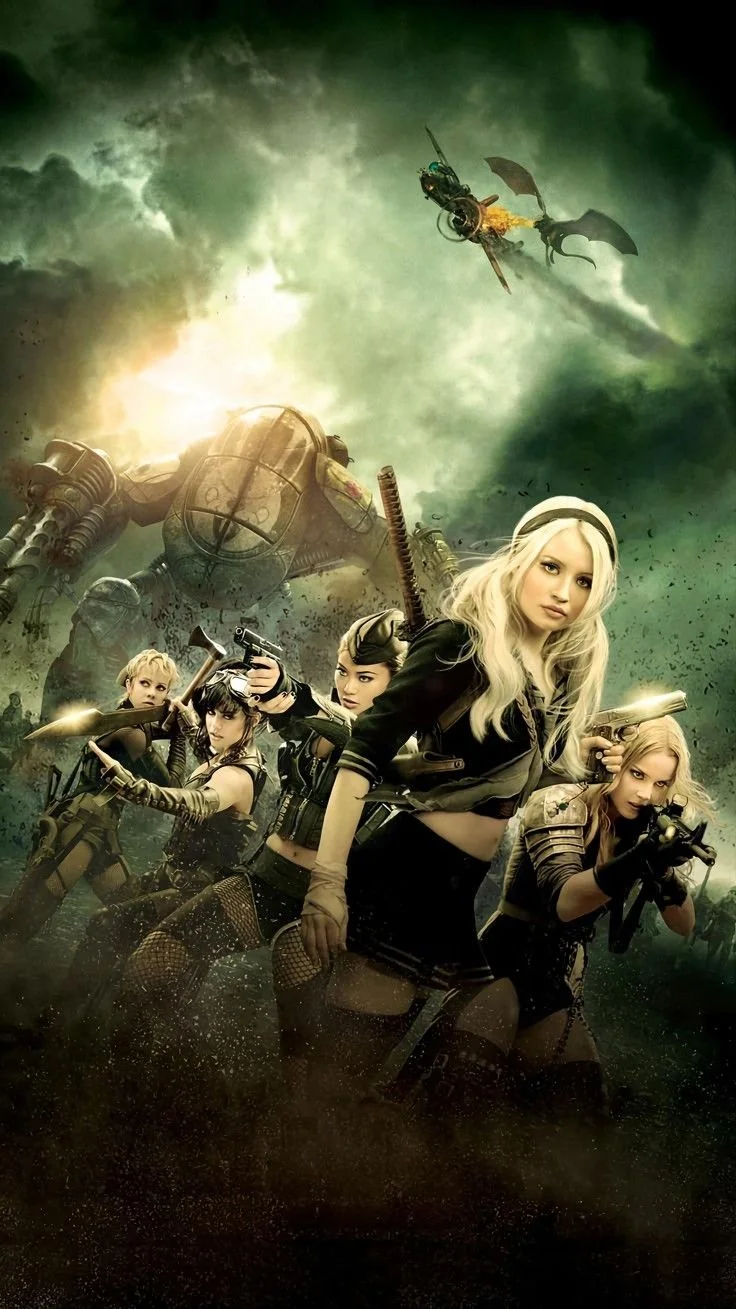
Suckerpunch
Suckerpunch is a fascinating film to look at through a mythic and psychological lens. Many viewers see it less as a literal story and more as an allegory for how the psyche survives overwhelming experiences.
Without making claims about the filmmakers' intentions, you could certainly read it this way:
The "real" world is unbearable. So the mind creates another world. Then another. Each layer becomes a symbolic landscape where impossible emotions can finally be experienced in a form the psyche can tolerate.
That's remarkably similar to how myths, dreams, active imagination, and guided visualization often work.
The dragons aren't necessarily dragons.
The fortress isn't necessarily a fortress.
The key isn't necessarily a key.
They're symbols carrying emotional truth.
This is one of the reasons I'm drawn to mythology as a framework for healing. The subconscious rarely speaks in bullet points or spreadsheets. It speaks in images, landscapes, characters, weather, impossible architecture, monsters, wise old women, forgotten children, abandoned houses, wolves at the edge of the forest.
It speaks the language of story.
When I guide someone in hypnosis, I'm not trying to convince them that they've literally entered another dimension or that every figure they encounter is an external spirit. Instead, I invite them to engage with the symbolic world that naturally emerges. Whether someone understands that world psychologically, spiritually, or as a blend of both is ultimately a matter of their own beliefs and experiences.
I've always loved this observation from mythologist Joseph Campbell: myths are "public dreams," while dreams are "private myths." Whether or not those were his exact original words in every retelling, the idea captures something profound. The psyche organizes experience through narrative and symbol.
That, to me, is what makes films like Suckerpunch so compelling. They're less about the plot than about the architecture of the inner world.
As a hypnotherapist, I don't think of hypnosis as putting ideas into someone's mind. I think of it as helping someone walk into the world their subconscious has already built.
Sometimes it looks like a cave.
Sometimes a forgotten library.
Sometimes a shoreline at dusk.
Sometimes an endless staircase.
Sometimes, like in Suckerpunch, it's an elaborate fantasy where every battle represents something the soul is trying to understand, survive, or transform.